From first contact to a confirmed booking
Before any work happens, a customer has to find you, get a clear answer, and actually end up on your calendar. Most of the leak in this phase happens quietly — a quote that goes unanswered, a booking that never gets confirmed.
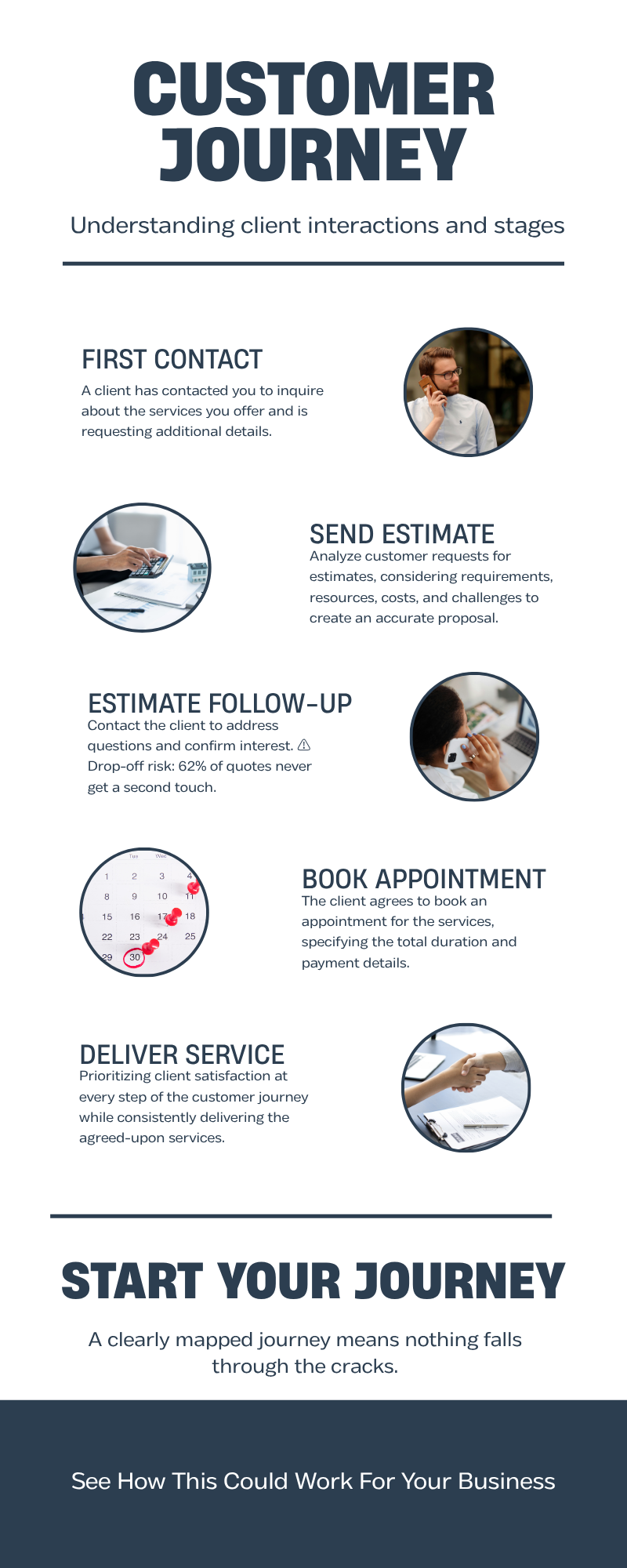
Where customers quietly drop off before they ever complain
Every customer goes through stages — contact, quote, booking, service, follow-up, repeat — but most businesses have never actually written theirs down. Once it's mapped, the drop-off points become obvious, and fixable.
Translated: this is customer journey mapping — identifying touchpoints and attrition points across the lifecycle.
Seeing your week before it's already full — or empty
Without a clear view of upcoming workload, it's easy to double-book a busy day or leave a slow one wide open. A simple shared calendar or capacity view turns "hoping it works out" into "knowing it works out."
Translated: this is basic capacity planning — matching booked workload against available hours before it becomes a problem.

From a confirmed booking to a completed, paid job
This is the work itself — getting supplies, tracking stock, doing the job, and getting paid for it. These systems are highly specific to each business, so they're typically scoped as custom work rather than packaged into a standard tier.
Buying smart vs. buying out of habit
Most solo operators reorder supplies when they notice they're running low — not before. That means rush orders, paying more than necessary, and occasionally running out mid-job, with no record of which vendor is actually reliable or cheapest.
Translated: this is basic vendor tracking and reorder-point planning — knowing your trigger quantity before you hit it, not after.

Replacing "I think we have some" with an actual answer
If "checking stock" means walking to the back room or scrolling old texts, that's memory — not a system. A simple sheet tracking what's on hand, what's committed, and when to reorder removes the guesswork.
Translated: a lightweight inventory control system — not enterprise software, just a single source of truth.

What actually happens during the job — and whether anyone could prove it
Most businesses can say what was sold and what was charged, but not what actually happened on-site or mid-project. No notes, no checklist, no record — so a dispute or a handoff has nothing to go on.
Translated: a basic delivery log or quality checkpoint — a record of what was done, not just what was promised.

The job's done. Did anyone get paid — and on time?
Work finishing doesn't mean money's collected. Invoices go out late, follow-up on overdue ones gets skipped because it feels awkward, and "I'll get to it" quietly becomes 60 days.
Translated: this is accounts receivable aging — tracking what's owed, by whom, and for how long.

From a completed job to a repeat customer or referral
A satisfied customer isn't the finish line — it's the moment right before a repeat sale or a referral. Without a deliberate next step, that opportunity quietly disappears.
What happens after the sale decides if there's a next one
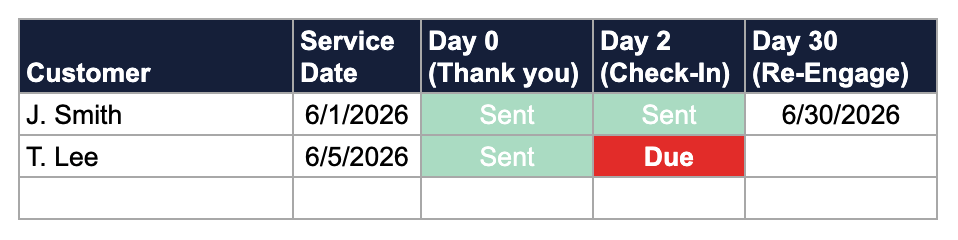
Most businesses are great in the moment and silent afterward. No thank-you, no check-in. That silence is read by customers as indifference — even when it's just a busy owner.
Translated: this is post-sale service consistency — standardizing the follow-up cadence so it doesn't depend on memory.
A happy customer who never hears from you again is a wasted customer
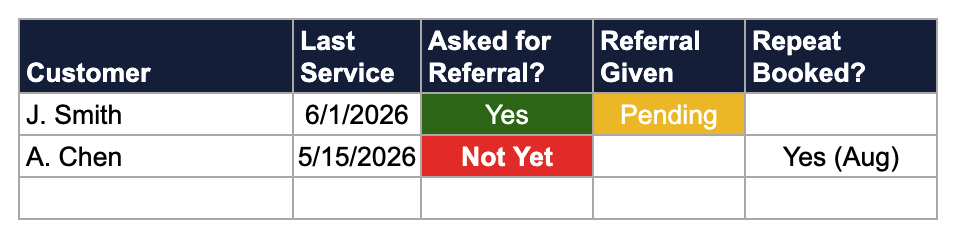
Most businesses treat "satisfied" as the finish line. It's actually the moment right before a second sale or a referral — and it disappears if nothing happens next.
Translated: repeat-purchase and referral-rate tracking — turning satisfaction into measurable, recurring revenue.
This isn't software you have to learn.
It's structure someone else builds for you.
If any of this sounds like your business, the next step is a short, honest conversation — not a commitment.